Table of Contents
- Why Commercial Properties Need Integrated Restoration and Reconstruction
- The Real Cost of Fragmented Restoration Services
- 24/7 Emergency Response and Stabilization for Your Chicago Business
- From Damage Assessment to Insurance-Aligned Documentation
- Seamless Transition from Mitigation to Full Reconstruction
- Construction Management and Quality Control Throughout Recovery
- Protecting Operations During Occupied or Phased Restoration
- Budget Certainty and Transparent Cost Management
- Navigating Permits, Codes, and Chicago Municipal Requirements
- Stakeholder Coordination Across Adjusters, Carriers, and Architects
- End-to-End Project Accountability and Timeline Control
- Getting Your Chicago Commercial Property Back to Business
- Frequently Asked Questions (FAQ)
Why Commercial Properties Need Integrated Restoration and Reconstruction
When a Chicago commercial property suffers fire, water, storm, or mold damage, the stakes extend far beyond structural repair. Your business operations, tenant relationships, insurance recovery, employee safety, and reputation all hang in the balance. The difference between a fragmented response and an integrated restoration strategy often determines whether you recover quickly or face months of delays, cost overruns, and operational disruption.
We understand that commercial property damage isn’t just a construction problem. It’s a business continuity crisis that requires rapid stabilization, meticulous insurance documentation, expert reconstruction, and transparent project control from day one. That’s why we’ve built Real Restoration Group around end-to-end delivery: one accountable partner managing emergency mitigation, assessment, insurance coordination, and full reconstruction on your timeline and budget.
Commercial properties are fundamentally more complex than residential losses. A damaged office building, retail space, industrial facility, or hospitality property typically involves multiple tenants, operational dependencies, insurance layers, code compliance requirements, and stakeholder approval chains that demand coordinated management.
When you fragment restoration across separate mitigation, reconstruction, and general construction contractors, each partner works within their own scope and timeline. Mitigation crews stabilize the property and leave. Insurance adjusters assess damage independently. Reconstruction contractors arrive weeks later to a property they didn’t evaluate. General contractors take over without full understanding of the mitigation work or restoration decisions already made. By the time you’re coordinating between three or four vendors, communication breaks down, schedules slip, and costs rise.
We approach commercial restoration as a single integrated process. From the first call through final inspection and occupancy, we manage assessment, mitigation, permitting, reconstruction, quality control, and stakeholder communication as one coherent project. That continuity protects your timeline, your budget, and your recovery.
The Real Cost of Fragmented Restoration Services
The financial impact of fragmented services extends beyond contract costs. When mitigation and reconstruction teams don’t share specifications, you risk incomplete drying that breeds hidden mold, improper damage assessment that leaves structural weakness, and reconstruction work that doesn’t align with insurance approval, forcing costly rework.
Coordination failures also extend your downtime. If your mitigation contractor clears out after three days without documenting their work or scheduling the next phase, your space sits in limbo while you hunt for the next vendor. Insurance claim disputes arise when different contractors submit conflicting damage reports. Permits delay because the reconstruction team wasn’t consulted during mitigation planning.
Our integrated model eliminates these gaps. We serve as your single point of accountability, managing interior documentation, structural assessment, drying protocols, permitting strategy, and reconstruction sequencing as one coordinated effort. That reduces timeline overlap, prevents costly rework, and ensures every phase is documented to support your insurance claim.
24/7 Emergency Response and Stabilization for Your Chicago Business
Commercial properties can’t wait for business hours. Water is actively damaging structure, electrical systems, and inventory. Fire suppression systems have flooded your space. Storm damage has exposed your roof and walls to weather. In these moments, the first 24 to 48 hours determine whether you can salvage equipment, contain secondary damage, and preserve business continuity.
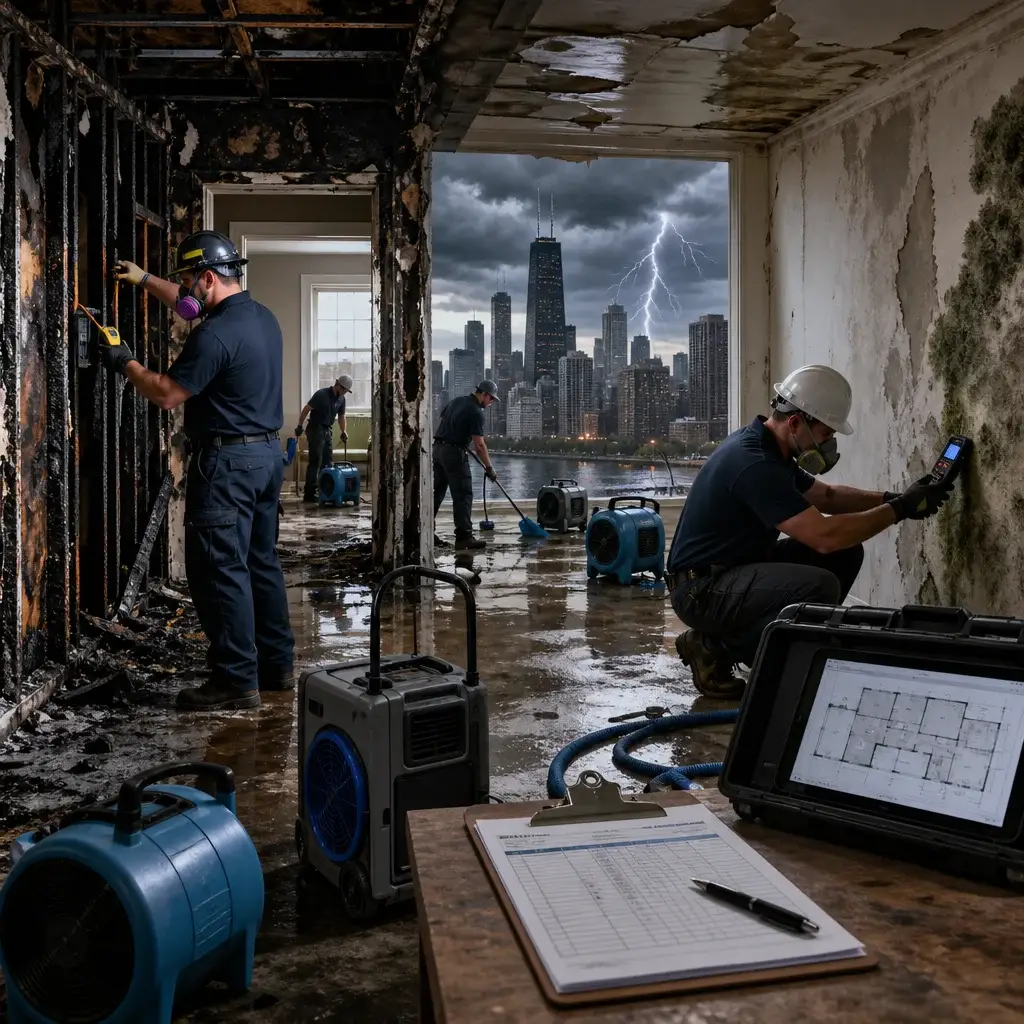
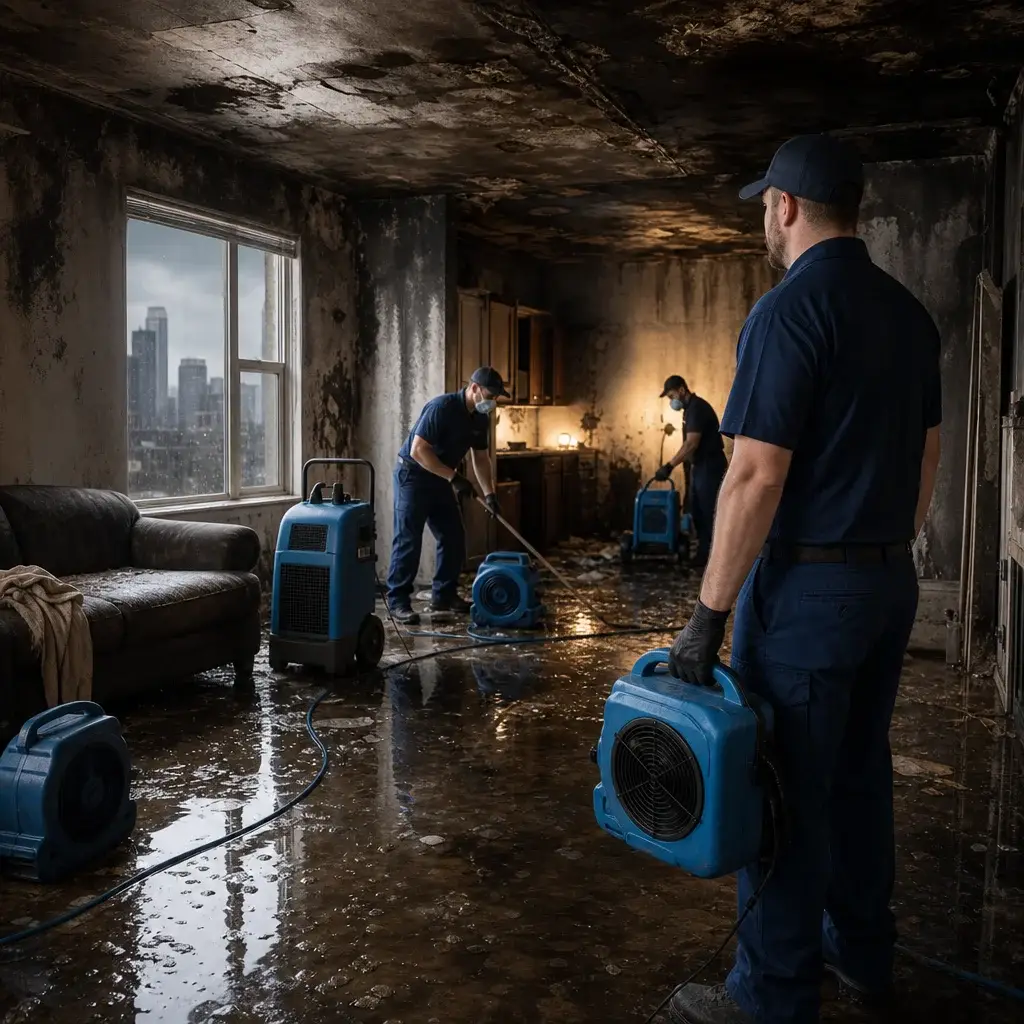
We maintain 24/7 emergency dispatch across Chicagoland. When you call, we arrive equipped with immediate stabilization capabilities: water extraction, structural drying equipment, temporary roof systems, board-up and tarping, emergency electrical and mechanical isolation, and damage documentation. We don’t wait for office hours or transfer your call to an answering service. A trained restoration team mobilizes to your property and begins work immediately.

Beyond speed, our early response captures critical information. We photograph pre-restoration conditions, measure moisture in walls and structural members, identify building systems at risk, and document contents and fixtures before deterioration advances. That early documentation becomes the foundation for accurate insurance claims and reconstruction planning.
From Damage Assessment to Insurance-Aligned Documentation
Insurance recovery depends on clear, defensible documentation of what was damaged, what failed, and what restoration or replacement was necessary. If your damage assessment is sloppy or doesn’t match your insurance policy language, claim disputes will delay payment and recovery.
We conduct thorough damage assessments from a restoration and construction perspective, not just emergency mitigation. Our evaluations identify visible and hidden damage, assess structural integrity, determine whether materials can be restored or must be replaced, and evaluate code compliance implications. Critically, we document findings in formats that align with insurance claim requirements: detailed reports, photographs, measurements, industry-standard estimating, and expert justifications for scope decisions.
When your insurance adjuster reviews our documentation, they see professional diligence. When your carrier’s engineer evaluates the loss, they find supporting evidence of our assessment methodology. That clarity accelerates claim approval and reduces the risk of coverage disputes that derail recovery.
Seamless Transition from Mitigation to Full Reconstruction
Mitigation is only the first phase. Once your property is stabilized and documented, reconstruction begins. For most commercial property owners, the gap between mitigation completion and reconstruction start is a vulnerability: the property is already damaged, the mitigation team has departed, and reconstruction hasn’t yet begun.
We manage that transition seamlessly. While mitigation teams are working, we’re already planning reconstruction, reviewing permits, coordinating with architects and engineers, and preparing material procurement schedules. The moment stabilization is complete, reconstruction crews are ready to mobilize. There’s no gap where your property sits exposed to weather or secondary damage.
Our integrated approach also means reconstruction decisions are informed by mitigation work already completed. We know the actual moisture content of structural members because we measured it. We understand mechanical and electrical system damage because we assessed it firsthand. That continuity produces faster, more accurate reconstruction planning and fewer surprises that delay schedules.
Construction Management and Quality Control Throughout Recovery
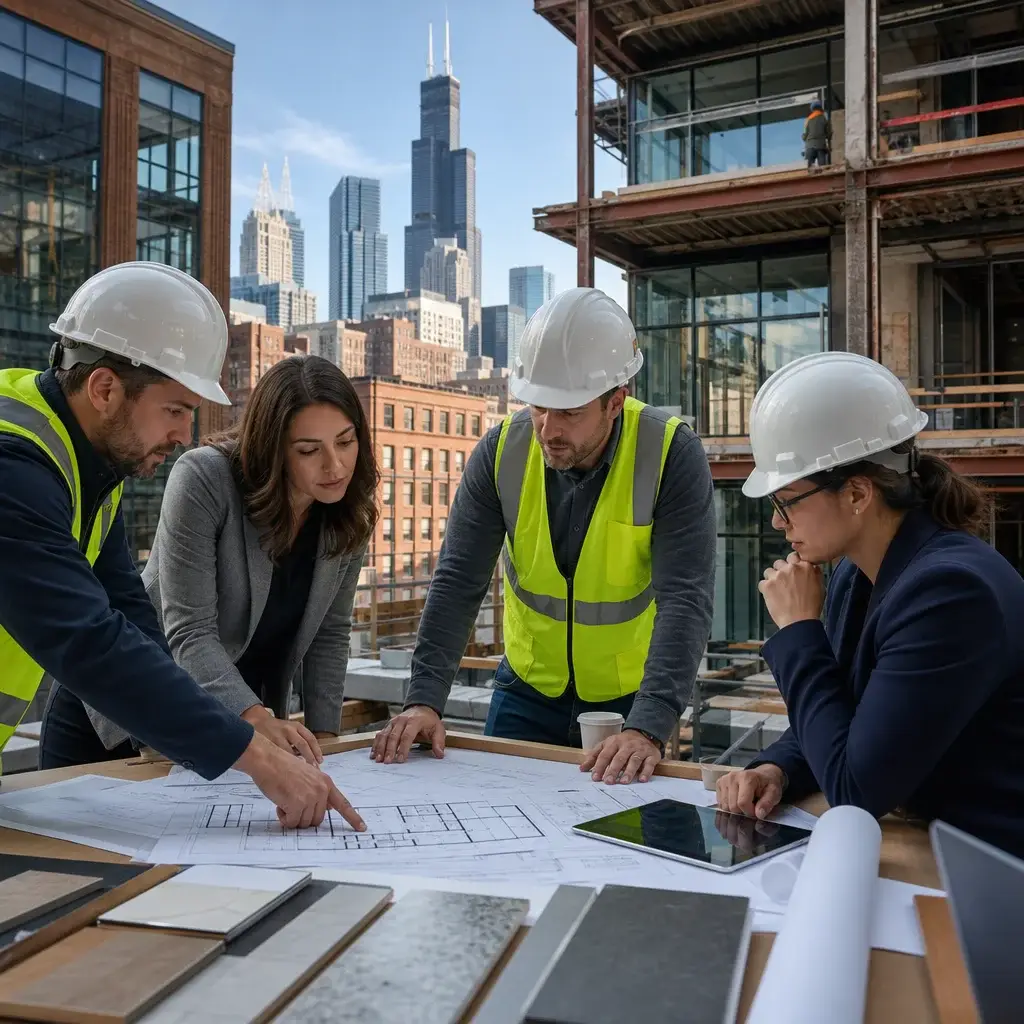
Reconstruction after commercial property damage isn’t standard new construction. You’re managing multiple subcontractors, coordinating with insurance adjusters and architects, maintaining occupied or phased access for tenants or operations, tracking change orders against insurance coverage, and ensuring quality meets both code requirements and your business standards.
Our construction management services provide that oversight and control. We manage daily scheduling, quality inspections, material deliveries, subcontractor coordination, and safety compliance. We track every change order, document justifications, and coordinate approval with your insurance carrier before costs escalate. We maintain regular communication with adjusters, carriers, and architects, preventing surprises and keeping the project aligned with policy limits.
Quality control is embedded throughout the process. Rather than inspecting finished work and finding problems, we conduct real-time inspections at critical stages: before wall closure, during structural repairs, at mechanical rough-ins, and before finishes. That proactive approach catches issues early, when they’re cheaper and faster to correct.
Protecting Operations During Occupied or Phased Restoration
For many commercial properties, partial occupancy continues during restoration. Tenants need functioning spaces, retail must stay operational, or healthcare facilities can’t relocate patients. Restoration work must proceed without disrupting those operations.

We’re experienced in managing construction in occupied, operationally sensitive environments. That means detailed phasing schedules that protect tenant access, coordination with operational staff before disruptive work begins, clear communication about noise, dust, and access restrictions, and contingency planning if restoration uncovers additional damage that affects sequencing.
We also implement dust and contamination control specific to occupied spaces. If mold remediation is required, we isolate work areas with temporary barriers and negative pressure systems. If asbestos or lead is present, we employ EPA Lead-Safe protocols and specialized contractors. Your occupants stay safe and informed, and restoration proceeds without operational interruption.
Budget Certainty and Transparent Cost Management
Insurance-driven restoration introduces financial complexity. Coverage limits, deductibles, exclusions, and policy language all affect what costs your carrier will cover and what you’ll pay from your pocket. If reconstruction budgets aren’t carefully aligned with policy coverage, you risk cost overruns that exceed your retention or are denied as outside policy scope.
We develop detailed pre-construction budgets that align scope and costs with your insurance coverage. We identify what’s covered under your policy, what falls outside coverage, and what qualifies as optional upgrades versus necessary replacement. Before work starts, you know what your insurance will pay and what your out-of-pocket exposure is.
Throughout the project, we manage change orders rigorously. When damage reveals additional work beyond the original scope, we document the discovery, photograph conditions, get adjuster approval, and obtain your authorization before proceeding. Transparency protects your budget and prevents bill shock at project completion.
Navigating Permits, Codes, and Chicago Municipal Requirements
Chicago’s permitting and code compliance requirements are intricate. Commercial properties trigger multiple permit categories depending on scope and use: structural permits if load-bearing elements are affected, mechanical and electrical permits if systems are being replaced, fire/life safety permits if egress or suppression systems change, and zoning compliance if the work affects use or occupancy.
Permit delays often derail post-damage recovery timelines. If you don’t submit permits early enough, or if your permit drawings don’t account for code-mandated upgrades, you face review cycles and revisions that stretch your schedule by weeks or months. We navigate that complexity as part of our integrated delivery.
Our team has deep familiarity with Chicago zoning, building code, and inspection processes. We coordinate with the Department of Buildings during pre-construction planning, submit complete permit packages that anticipate reviewer questions, and manage inspections throughout construction. That expertise accelerates permitting and keeps your recovery on track.
Stakeholder Coordination Across Adjusters, Carriers, and Architects
Commercial property restoration involves multiple stakeholders with different priorities. Your insurance adjuster wants to confirm the scope and approve costs. Your carrier’s engineer may question repair versus replacement decisions. Your architect may recommend design improvements that fall outside insurance coverage. Your tenants need information about their spaces. Your lenders may require approvals.
Coordinating across all those voices without a clear traffic manager creates confusion, delays approvals, and introduces conflicting direction. We serve as your project hub, translating between technical restoration decisions and insurance policy language, facilitating communication between adjusters and reconstruction teams, documenting agreements and approvals, and keeping all parties informed about progress and timeline.
That coordination reduces your burden significantly. You’re not juggling phone calls with adjusters, contractors, and architects. We manage that dialogue, escalate issues appropriately, and keep the project moving forward aligned with everyone’s interests.
End-to-End Project Accountability and Timeline Control

The fundamental value of integrated commercial restoration is accountability. You have one partner responsible for the entire recovery process, from the first call through final completion. That accountability eliminates the blame-shifting that happens when multiple vendors are involved, accelerates decision-making because you’re not coordinating approvals across separate contracts, and creates a single timeline you can rely on.
We take ownership of your recovery. If we discover additional damage during reconstruction, we’re already equipped to address it rather than passing responsibility to another contractor. If permitting delays surface, we’re responsible for solving them, not waiting for someone else to act. If insurance and construction scope don’t align, we work that issue until it’s resolved.
That ownership also means we’re invested in your success, not just our contract deliverables. If staying on schedule requires coordination above and beyond standard reconstruction scope, we manage it. If protecting your budget requires value engineering or phasing decisions, we provide that counsel.
Getting Your Chicago Commercial Property Back to Business
Recovery from commercial property damage is stressful. Beyond the immediate crisis of stabilizing your property, you’re managing insurance claims, navigating permitting, coordinating multiple vendors, and trying to minimize operational downtime. The uncertainty around timeline and cost compounds the stress.
Real Restoration Group simplifies that process. We manage the complete recovery journey: emergency stabilization within hours of your call, professional damage assessment aligned with insurance requirements, integrated reconstruction planning that respects both code compliance and your budget, transparent cost management with clear approval workflows, and consistent communication about progress and timeline.
If your Chicago commercial property has suffered fire, water, storm, mold, or other damage, contact us for a rapid damage assessment and recovery plan. We’re available 24/7 and ready to begin stabilization and restoration coordination immediately. Your recovery timeline and budget deserve a partner who’s accountable for the entire process, not just one piece of it.
Whether you’re responding to property damage, navigating an insurance-driven restoration, or planning a construction project, Real Restoration Group brings the expertise, accountability, and end-to-end coordination to move it forward. Contact our Chicagoland team to discuss your project, or get 24/7 emergency help when immediate response matters.
Frequently Asked Questions (FAQ)
How quickly can we respond to commercial property damage in Chicago?
We maintain a 24/7 emergency response team ready to dispatch to your property within hours of your call. Our rapid stabilization protocols focus on preventing secondary damage, securing your space, and documenting conditions for insurance purposes from day one. We understand that downtime directly impacts your bottom line, so our immediate priority is stopping the loss and positioning you for the fastest possible recovery.
Why does using one contractor for both restoration and reconstruction matter?
Fragmented services create gaps in accountability, budget control, and timeline management that cost you time and money. We handle everything from emergency mitigation through final reconstruction under a single, transparent contract with one point of responsibility. This integrated approach eliminates contractor coordination delays, ensures consistent quality standards, and gives you clear visibility into budget and schedule from start to finish.
How do we manage restoration work while your business continues operating?
We specialize in phased and occupied construction protocols that minimize operational disruption to your team, customers, and tenants. Our project management team coordinates sequencing, access, noise control, and safety barriers to keep your business running while work progresses. We work with your facility team to establish protocols that protect your operations and maintain normal business flow throughout the recovery process.